
The Silence, the Delay, and the Blunder: When Albany’s “Significant Threat” Evaporates in a Puff of Bureaucratic Smoke

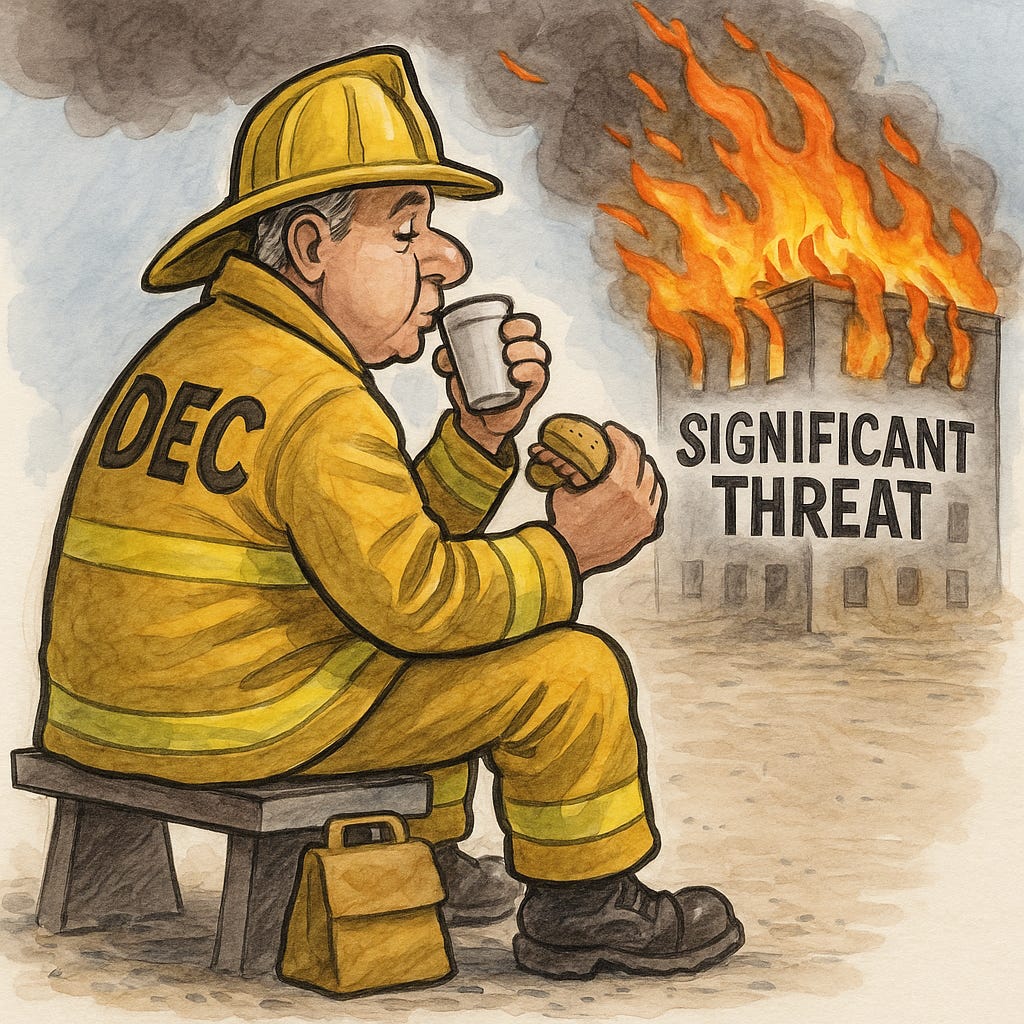
What a day in the great theater of New York “justice.” The curtain rose on silence—On Friday, the clerk said the response to the NY Attorney General’s request for more time would come on Monday. Then five days of judicial quiet followed, so thick you could hear the State sweating through its suit. I posted my blog about this morning as the tension filled the air. So much so, that Assistant AG Buttino wads forced to shoot off an email to the clerk, nervously asking about a response to his request for more time. Then, late in the afternoon, came the ruling: Judge Baker granted the Attorney General’s request for more time. More time!
And in that one stroke, the myth of a “significant threat to public health or the environment” collapsed under its own bureaucratic weight. Because if there truly were an environmental emergency of any size—if my Elmira property at 714 Baldwin Street were the ticking toxic time bomb the DEC insists it is—then neither the Department nor the Court could in good conscience delay for sixty days!
The silence before the ruling spoke volumes. That pause was not indifference—it was scrutiny. The judge had to read and possibly reread my pleadings, weighed the record, and recognized the truth: the only real threat here isn’t environmental. It’s institutional. It’s a threat to property rights, to due process, to every citizen who dares to stand up to an unelected bureaucracy that wields its power like a weapon and calls it “protection.”
So yes, Baker granted the extension. But that act, in its irony, amounts to an admission from the bench that there is no significant threat—none, except to me. Because I remain under a statutory sword that still dangles, courtesy of the DEC’s unlawful classification, its coercive threats, and its history of advancing even while litigation is pending.
Let’s not forget: Nicholas J. Buttino, Assistant Attorney General, is no novice. He litigated for the DEC in Adirondack Wild, where the Department kept working on the literal field while the case was still before the court. He knows this playbook by heart—stall, smile, and keep digging. That’s why his request for “holiday time” reeked not of need but of strategy: a desperate attempt to engineer a fix for what’s already in the record, laid bare for all to see.
And yet, by begging for delay, the DEC has confessed its own lie. No agency that truly believes it faces an urgent environmental hazard pleads for two months to prepare a response. It’s the bureaucratic equivalent of a firefighter asking to finish lunch before putting out the blaze.
So now comes my TRO(temporary restraining order)—the rope to bind the very hands that have been clawing through due process. The Department has already proven that, left unrestrained, it will act despite pending litigation. The Court must now decide whether to preserve the integrity of judicial review or allow DEC’s machinery to roll forward, altering records, moving soil, or rewriting the past in real time.
If Baker grants the TRO—and he must—it will be the neatest symmetry of all: the Court giving the State all the time it begged for, but none of the freedom to use it. They’ll have months to “review my extensive filings,” as they claimed to need—just not to make another mess.
A blunder for the DEC? Absolutely. A turning point for justice? We’ll soon find out.
Ha!